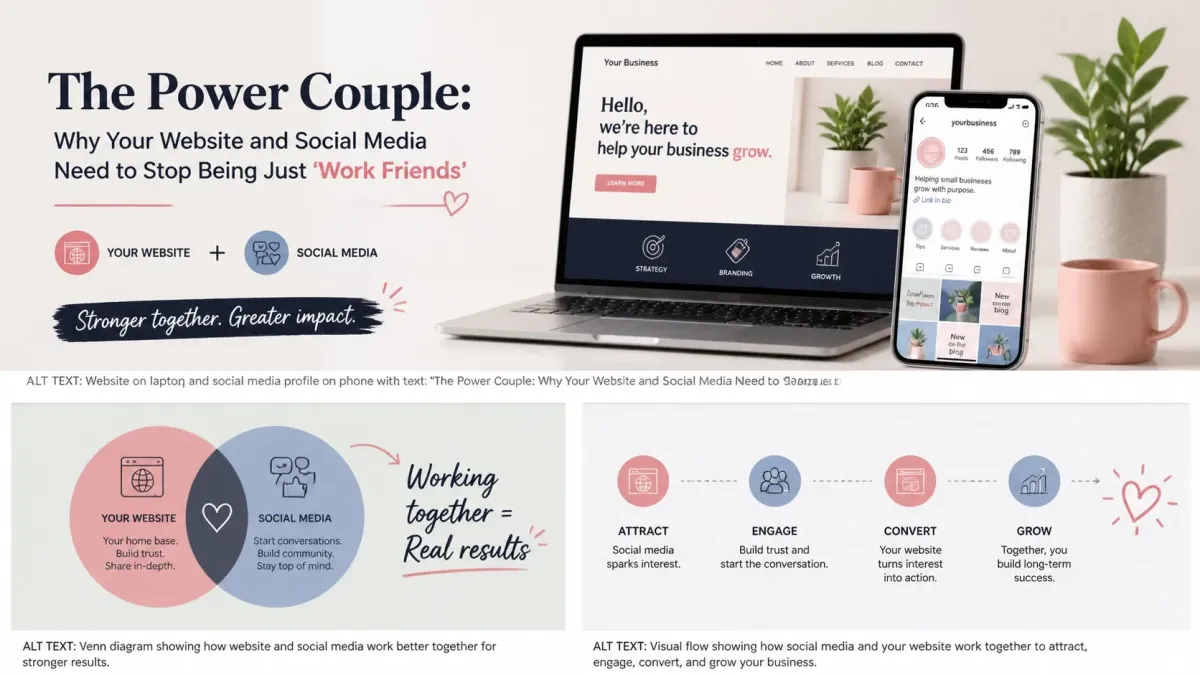
The Power Couple: Why Your Website and Social Media Need to Stop Being Just ‘Work Friends’
The Power Couple: Why Your Website and Social Media Need to Stop Being Just ‘Work Friends’
May 15, 2026
7 min read
Let’s be honest for a second. In the world of UK small business marketing, your website and your social media accounts are often like two colleagues who work in the same office but have absolutely no idea what the other one actually does.
They might nod at each other in the corridor (or have a link in a bio), but they aren’t exactly sharing a desk or grabbing a pint after work. One is busy posting pictures of office dogs and “behind the scenes” reels, while the other is sitting there, slightly dusty, waiting for someone to fill out a contact form that hasn’t been updated since the 2012 Olympics.
If this sounds like your business, we need to have a chat. Treating your website and social media as separate entities is a bit like buying a fancy Italian sports car but refusing to put tyres on it. It looks great on the driveway, but it’s not taking you anywhere.
At Donut Pig Digital Marketing, we see this all the time. But to truly win the digital game, these two need to stop being “work friends” and start being the ultimate power couple.
The Social Media Side: The “Loud One” at the Party
Think of social media as the “reach” machine. Whether you are buzzing on TikTok or sharing industry insights on LinkedIn, social media is your megaphone. It’s where you find your audience, start conversations, and show off your brand’s personality.
Social media is fantastic for:
Brand Awareness: Getting your face (or your products) in front of people who didn’t know you existed five minutes ago.
Engagement: Actually talking to your customers. It’s a two-way street, not a lecture.
Quick Updates: Sharing that you’ve got a flash sale on or that the office pig has finally learned to sit.
But here is the straight-talking truth: you don’t own your social media. If Mark Zuckerberg decides to change the algorithm tomorrow (which he will) or if Elon Musk decides to rename his platform after another letter of the alphabet, your reach can vanish overnight.
Relying solely on social media is like building a house on a rented field. It’s great until the landlord decides he wants to graze sheep there instead.
The Website Side: The “Closer” Who Gets the Job Done
If social media is the party where you meet people, your website is your home. It’s the place where the serious stuff happens. It’s where the “reach” you’ve built on social media turns into “revenue.”
Your website is the ultimate conversion tool because:
You Own the Land: Nobody can take your website away or hide your content behind a “pay-for-reach” wall.
Credibility: A professional website tells a customer, “I’m a real business, not just a bloke with a smartphone.”
Information Hub: It’s where you can go deep into your services, showcase your portfolio, and answer those burning questions.
However, a website without traffic is just a very expensive digital brochure. You could have the most beautiful site in the UK, but if nobody is visiting it, it’s about as useful as a chocolate teapot.
Why They Need to Start Dating (The Synergy)
When you link your website and social media effectively, magic happens. You move from “hoping people find me” to “leading people to me.” This is what we call an integrated marketing strategy.
Imagine this journey:
A potential customer sees a witty, engaging post on your Facebook page.
They think, “These lot seem to know their stuff,” and click the link in your bio.
They land on a specific, high-quality blog post on your website that solves a problem for them.
While there, they see your professional work with clients like Momentum Transformation or Highland Rentals.
They feel the trust, see the authority, and click “Grab a Quote.”
That is a seamless transition from reach to conversion. Without the social post, they never find you. Without the website, they never buy from you.
Common Mistakes Small Businesses Make
We’ve seen it all at Donut Pig, and usually, the “disaster” happens in the gaps between the two platforms. Here are the big ones:
1. The Dead-End Link
You spend hours on a Instagram post, tell people to “click the link in bio,” and that link just sends them to your homepage. Your homepage is probably fine, but if your post was about a specific service, send them to that specific page! Don’t make them hunt for it. People are lazy; if they have to click more than twice, they’re gone.
2. The Ghost Town Website
Your social media is updated daily with fresh content, but your website’s business news section hasn’t seen an update since 2019. This creates a “trust gap.” A customer sees you’re active on X (formerly Twitter) but then sees a “Copyright 2021” footer on your site and wonders if you’re still actually in business.
3. Ignoring the Data
Your website has a goldmine of data (thanks to things like the Meta Pixel or Google Analytics). If you aren’t using your website data to inform who you target on social media, you’re just throwing spaghetti at the wall and hoping it sticks.
“Marketing without a website is a conversation without a destination. Marketing without social media is a destination without a map.”
How to Get Them Working Together (The Donut Pig Way)
So, how do we fix this? How do we make sure your digital presence is as sweet and well-rounded as a fresh glazed donut? (See what I did there? I’ve been told a donut nod is mandatory, and frankly, I’m hungry now).
1. Consistent Branding
Your tone of voice, your colours, and your “vibe” should be the same whether someone is looking at your X profile or your “About Us” page. If your social media is “witty and casual” but your website is “stuffy and corporate,” you’ll confuse people. Stay consistent.
2. Social Proof on the Website
Don’t just leave those lovely reviews and user-generated photos on social media. Embed them on your website! Show potential customers that real people are talking about you. Look at how Trustist Dave Marshall leverages reputation, that’s the kind of energy you need.
3. The Content Loop
Create a “Big Rock” piece of content for your website (like a 1,500-word guide on your industry). Then, chop that up into ten smaller “pebbles” for social media. One blog post can become three LinkedIn articles, five Instagram stories, and a TikTok video. You’re driving people back to the “Big Rock” on your site, where the conversion happens.
The “Sonny” Workflow
Speaking of getting things done, I’ve got my colleague Sonny on standby. While I’m here crafting these long-form masterpieces to boost your SEO and authority, Sonny is the wizard who takes these ideas and turns them into thumb-stopping social media posts.
By having a system where the blog (the website) and the posts (the social media) are created together, you ensure that the message never gets lost in translation. It’s a unified front. It’s the power couple in action.
Summary: Stop Doing Half the Job
UK small business owners are some of the hardest-working people on the planet. But many are working twice as hard because their digital tools aren’t talking to each other.
Stop treating your website as a static document and your social media as a digital scrapbook. Make them work in tandem. Use social media to find the crowd, and use your website to sign the contract.
If your website is looking a bit lonely or your social media feels like it’s shouting into the void, it might be time for a professional “matchmaker” to step in.
Grab a quote today, and let’s get your digital marketing joined up properly. No more “work friends”, let’s make them the ultimate power couple.
Suggested Keywords
Primary Keyword: Website and social media integration
Secondary Keywords: Small business marketing UK, digital marketing strategy, social media reach, website conversion tips, integrated marketing approach.
FAQs
1. Should I focus on my website or social media first?
Ideally, both! However, if you have limited time, ensure your website (your “home”) is professional and functional first. There is no point driving traffic from social media to a website that doesn’t work.
2. How often should I link to my website from social media?
Don’t be “spammy,” but every post should have a purpose. If you’re providing value, people won’t mind a link. A good rule of thumb is the 80/20 rule: 80% value/entertainment, 20% direct links to your site.
3. Do I really need a website if I have a massive Facebook following?
Yes. You don’t own Facebook. If the platform goes down or your account is hacked, you lose your entire business. Your website is the only piece of digital real estate you truly control.
4. Can social media help my website’s SEO?
Indirectly, yes! While social signals aren’t a direct ranking factor, the traffic you drive to your site and the brand awareness you build can lead to more searches for your business and more backlinks, which do help SEO.
5. Is it expensive to integrate the two?
It’s more about strategy than cost. Using consistent branding and linking your content correctly costs nothing but time. For more advanced setups like retargeting ads, we can help you find a budget that works.
Grab a quote if you want to see how we can make it work for you!